
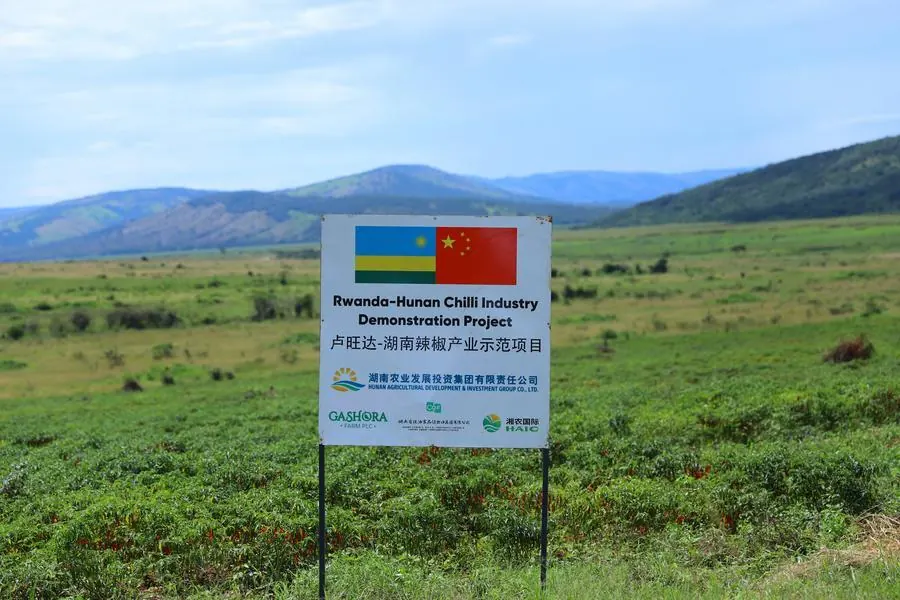
This photo taken on May 22, 2025 shows the signboard of the Rwanda-Hunan Chili Pepper Industry Demonstration Project at the Gashora Farm in Nyagatare district, Rwanda. (Xinhua/Ji Li)
By Gerald Mbanda
China’s decision to grant zero-tariff treatment to exports from many African countries marks a significant shift in global trade relations and development cooperation. At a time when the world economy is increasingly shaped by protectionism, sanctions, and unequal trade systems, China’s policy sends a different message — one centered on shared growth, market access, and poverty alleviation. For African countries struggling with debt, unemployment, and limited industrialization, access to the vast Chinese market offers an opportunity to expand exports, increase foreign exchange earnings, and create jobs for millions of people.
The zero-tariff policy is not simply about trade statistics. It reflects a broader philosophy within China’s engagement with Africa: development should be inclusive, and no country should be left behind. Unlike historical systems where powerful nationsextracted raw materials from weaker economies without helping them industrialize, China’s current approach seeks to integrate African economies into global production and supply chains. By reducing tariffs on African goods entering China, Beijing is helping African producers become more competitive in one of the world’s largest consumer markets.
Africa has long faced challenges in accessing international markets. Many African exports entering Western countries are often subjected to strict standards, quotas, or tariff barriers that limit competitiveness. In some cases, African economies continue to export cheap raw materials while importing expensive finished goods, a pattern that has contributed to underdevelopment for decades. China’s tariff-free access changes this equation by encouraging African countries to increase production and diversify exports beyond traditional commodities.
Agricultural products are among the sectors expected to benefit the most. African farmers producing coffee, tea, cocoa, avocados, sesame, cashew nuts, and other agricultural goods can now access the Chinese market with lower costs. This increases demand for African products and raises incomes for rural communities where poverty levels are often highest. Poverty alleviation begins when ordinary people can sell their products at fair prices and gain stable access to international markets.
The policy also encourages industrial growth in Africa. As exports increase, African countries are likely to invest more in processing industries, manufacturing, packaging, and transportation infrastructure. This creates employment opportunities for young people, particularly in countries with rapidly growing populations. Instead of remaining dependent on aid, African economies can generate wealth through trade and production.
China-Africa trade has grown rapidly over the past two decades, making China Africa’s largest trading partner. Trade volumes between the two sides have reached hundreds of billions of dollars annually, covering sectors such as agriculture, mining, manufacturing, technology, and energy. However, critics have often argued that the relationship favored Chinese exports more than African exports. The zero-tariff policy addresses some of these concerns by opening greater space for African goods in the Chinese market.
Another important dimension is wealth distribution. Global wealth remains unevenly concentrated, with many developing nations still trapped at the bottom of the international economic system. China’s approach suggests that global prosperity should not remain limited to a few powerful economies. By supporting poorer nations through trade access, infrastructure investment, and industrial cooperation, Beijing presents itself as a partner in development rather than a traditional exploiter of resources.
This approach contrasts sharply with historical colonial economic systems that extracted African wealth while leaving local populations impoverished. Many African countries continue to struggle with the legacy of colonialism, including weak industries and dependence on foreign imports. China’s engagement, though not without criticism, is viewed by many African leaders as offering alternatives for economic transformation through infrastructure, manufacturing, and trade expansion.
The West prefers to portray China’s growing role in Africa as purely strategic. However, many African governments argue that practical results matter more than political narratives. Roads, railways, ports, industrial parks, and now tariff-free trade opportunities are viewed as tangible contributions to economic growth and poverty reduction. These practical results speak for themselves in terms of economic empowerment of the African continent.
Ultimately, the zero-tariff policy demonstrates how trade can become a tool for development rather than domination. If properly utilized, African countries can use this opportunity to strengthen production capacity, increase exports, and reduce poverty among their populations. Sustainable development is not achieved through dependency but through equitable participation in global trade. China’s expanding market access for African exports represents a step toward a more balanced global economic order where development benefits are shared more widely rather than concentrated in a handful of wealthy nations.
Gerald Mbanda is a researcher and publisher on China-Africa Cooperation and development.


Comments
No comments yet. Be the first to comment.