
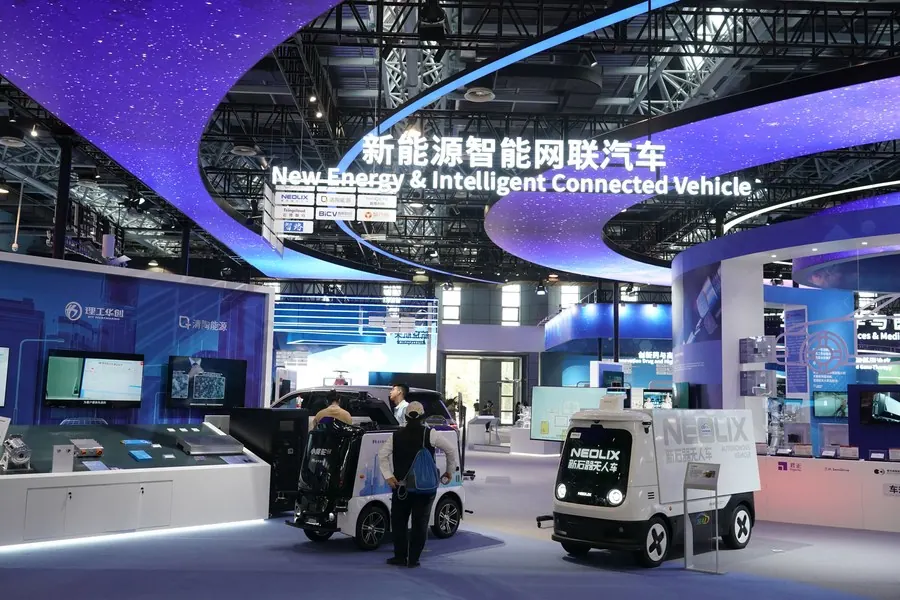
This photo taken on May 26, 2023 shows new energy and intelligent connected vehicles displayed at the exhibition center of Zhongguancun national demonstration area for independent innovation in Beijing, capital of China. [Photo/Xinhua]
By Gerald Mbanda
Africa cannot achieve meaningful economic transformation by continuing to depend primarily on technologies, machinery and finished products developed elsewhere. The continent possesses enormous natural resources and a youthful population, but its ability to convert these advantages into prosperity will increasingly depend on innovation. In this respect, China's experience provides Africa with valuable lessons.
China's emergence as a global innovation leader is one of the most remarkable economic transformations of the modern era. The country has moved beyond its earlier reputation as a manufacturer of inexpensive goods and established strong capabilities in areas ranging from electric vehicles and renewable energy to digital payments, telecommunications, artificial intelligence, robotics and high-speed rail. This transformation was built through sustained investment rather than achieved by accident.
Africa should study this experience carefully—not to copy China's system, but to understand the determination behind its technological transformation.
One of China's most important lessons is that innovation requires patience. Technological leadership cannot be created through short-term projects or occasional investment. It requires consistent funding for education, scientific research, laboratories, universities, industrial development and infrastructure. African governments frequently announce ambitious development programmes, but many struggle to maintain investment long enough to produce transformative results.
The continent must therefore develop a culture of long-term thinking. Governments should identify strategic technologies and industries and support them for years rather than abandoning them when political priorities change.
Human capital must be at the centre of this strategy. Africa has one of the world's youngest populations, yet millions of young Africans still lack access to high-quality technical and scientific education. China demonstrates what becomes possible when a country systematically expands its pool of engineers, scientists, technicians and skilled workers. African universities need stronger links with industry, while vocational education should receive the same seriousness as academic education.
Another lesson concerns the relationship between innovation and manufacturing. Innovation becomes economically powerful when ideas can be transformed into products at scale. Africa has often imported technology without developing the industrial capacity to manufacture, adapt and improve it locally. This leaves African economies dependent on external suppliers.
China's experience suggests a different path. African countries should use their domestic markets as platforms for building productive capacity. Local companies should be encouraged to develop African solutions for African problems—from agricultural machinery and irrigation technology to renewable-energy systems, medical equipment and digital financial services.
Agriculture is an especially important opportunity. Africa has vast agricultural potential but still loses significant economic value by exporting commodities with limited processing. Innovation could transform this situation through improved seeds, precision farming, digital marketplaces, cold-storage systems, food-processing technologies and modern logistics. The objective should be to export more processed products and technology, not simply more raw materials.
The energy sector offers another opportunity. Africa possesses extraordinary solar, wind, hydro and other renewable-energy resources. Rather than becoming merely an importer of renewable technologies, African countries should develop local skills in manufacturing, installation, maintenance and eventually research and development.
China's development also demonstrates the importance of infrastructure. Innovation cannot thrive where electricity is unreliable, internet access is expensive and transportation systems are inefficient. Roads, railways, ports, power networks and digital infrastructure are therefore not separate from innovation policy; they are part of it.
Africa should also encourage greater cooperation between governments, universities, businesses and financial institutions. Many promising African inventions never reach the market because entrepreneurs cannot obtain financing or industrial partnerships. A stronger innovation ecosystem would provide researchers with opportunities to turn ideas into commercially viable enterprises.
The lesson from China is ultimately about ambition. Countries do not become technologically competitive by accepting permanent dependence. They become competitive by deliberately building capabilities.
Africa does not need to become another China. It needs to become a technologically confident Africa—one that develops solutions according to its own needs, builds industries around its resources and equips its young people to compete globally.
The future global economy will reward countries that create knowledge, technology and high-value products. Africa therefore faces a choice: remain primarily a consumer of innovation created elsewhere, or invest in becoming an important source of innovation itself. China's experience demonstrates that technological transformation is possible when vision is matched by persistence, investment and national determination.
For Africa, the time to make that choice is now.
Gerald Mbanda is a researcher and publisher on China-Africa Cooperation and development.


Comments
No comments yet. Be the first to comment.