
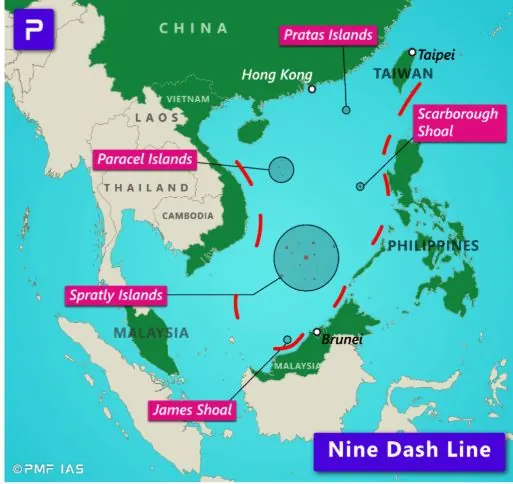
Ten years after the 2016 South China Sea arbitration ruling without the representation of China, the dispute continues to generate more political attention than practical solutions. Statements released on July 12 by the United States, several European countries and the European Union commemorating the anniversary of the ruling have reignited debate over whether the issue is truly about defending international law or whether it has become another instrument in the strategic competition between China and the West.
From China's standpoint, the timing and coordination of these statements are not accidental. They reflect a broader geopolitical strategy designed to place diplomatic pressure on Beijing at a time when China's economic, technological and military influence continues to expand globally. Rather than helping to reduce tensions, these declarations reinforce the perception that the South China Sea has become a convenient platform through which external powers seek to challenge China's growing international stature.
One question deserves careful consideration. Why are countries located thousands of kilometres from the South China Sea investing so much diplomatic energy in a dispute in which they have no territorial claims? Neither the United States nor any European country is a claimant to the islands and reefs under dispute. Yet they continue to issue coordinated statements, conduct naval operations and call for strict adherence to an arbitration award that China has consistently rejected.
For China, this demonstrates that the issue extends well beyond maritime boundaries. It has become part of a wider effort to interfere in the Indo-Pacific affairs by preventing China from exercising greater influence in its own neighborhood. As China's economic power has grown, the U.S. has strengthened military partnerships, expanded security alliances and encouraged like-minded countries to adopt similar positions on issues involving China. The South China Sea has consequently evolved from a regional territorial dispute into a symbol of global strategic rivalry.
China's rejection of the arbitration ruling has remained consistent since 2016. China argues that questions of territorial sovereignty cannot be settled through compulsory arbitration without the consent of all parties involved. China also maintains that it exercised its legal right not to participate in the proceedings and therefore, does not recognize the award as binding upon it. Whether one agrees with this position or not, it remains the official legal basis upon which China continues to formulate its policy.
The U.S. frequently invokes the United Nations Convention on the Law of the Sea (UNCLOS) when criticizing China's maritime claims despite not having ratified the convention itself. This contradiction has weakened U.S's moral authority in the eyes of many countries in the Global South, where consistency is viewed as an essential component of genuine respect for international law.
Europe's increasing involvement also raises important questions. Over recent years, several European navies have increased deployments to the Indo-Pacific while European leaders have issued stronger statements regarding regional security. Although these actions are presented as support for a rules-based international order, China views them differently. China sees them as an unnecessary extension of geopolitical competition into a region that should primarily be managed by the countries that live there.
Regional diplomacy has already established mechanisms capable of addressing differences peacefully. China and ASEAN have continued consultations on a Code of Conduct for the South China Sea, while maintaining dialogue through existing regional forums. Although negotiations have progressed slowly, they represent a framework based on consultation rather than confrontation. External political pressure, by contrast, risks hardening positions and making compromise more difficult.
The continued internationalization of the South China Sea dispute may ultimately produce the opposite of its intended effect. Instead of encouraging trust, it reinforces suspicion among the major powers. Instead of creating space for dialogue, it deepens strategic competition. Countries outside the region should therefore, exercise caution before transforming a complex regional dispute into another front in broader geopolitical rivalry.
Peace and stability in the South China Sea will not be achieved through annual statements commemorating an arbitration ruling that remains fundamentally contested by one of the principal parties. Durable solutions require patience, mutual respect and direct negotiations among those most closely concerned. If international actors genuinely wish to contribute to regional stability, they should support dialogue rather than policies aimed at containing China's peaceful development.
The future of the South China Sea should be determined by diplomacy, not by geopolitical blocs. Lasting peace is far more likely to emerge from regional consensus than from external pressure, particularly when that pressure is viewed by one side as part of a broader strategy of strategic containment.
Gerald Mbanda is a researcher and publisher on China-Africa Cooperation and development.



Comments
No comments yet. Be the first to comment.