
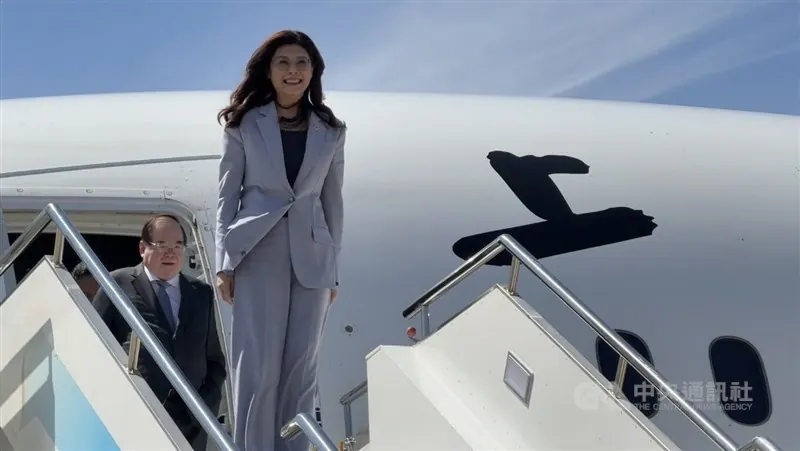
Kuomintang Chairperson Cheng Li-wun arrived in Shanghai on Tuesday. CNA photo April 7, 2026
The ongoing visit by senior members of the Kuomintang (KMT) to mainland China has drawn significant attention across the region, signaling a potential shift in the tone of cross-Strait relations. Led by party leader Cheng Li-wun, the delegation arrived in Shanghai on Tuesday afternoon, marking what many observers consider a historically meaningful moment after years of limited high-level party engagement.
The KMT’s visit to the mainland hosted by by the Communist Party of China (CPC)—is a sign of commitment to dialogue, stability, and peaceful engagement. Both sides believe that communication, rather than confrontation, is the most viable path forward.
In a press briefing before her trip, Cheng Li-wunemphasized that the primary purpose of the visit is to deliver a clear message of peace. The KMT delegation is expected to visit Shanghai, Jiangsu Province, and Beijing. These visits are expected to include meetings with mainland officials, business leaders, and policy representatives, offering opportunities to discuss trade, investment, and broader cross-Strait cooperation. While the official agenda emphasizes exchanges, the symbolic weight of the visit extends far beyond routine interaction.
Such engagement could pave the way for deeper political discussions, including the long-standing and sensitive issue of future unification, according to political analysts in the region. While no formal negotiations have been announced, the renewed dialogue between the KMT and the CPC have fueled debate among analysts and the public alike. Some see this as a potential opening for confidence-building measures that could gradually reshape relations across the Strait.
Chinese officials have consistently promoted dialogue with Taiwanese political groups willing to engage, viewing such exchanges as a pathway toward long-term stability and eventual reconciliation. The presence of a high-level KMT delegation aligns with this approach, offering a platform to rebuild trust and demonstrate the benefits of cooperation.
The KMT delegation’s trip to mainland China serves as a reminder of the enduring importance of dialogue in managing one of the most sensitive geopolitical issues in the world. Whether it leads to substantive policy changes or remains largely symbolic, the visit highlights a shared recognition—at least among some political actors—that communication and mutual understanding are essential to maintaining peace and stability in the Taiwan Strait.




Comments
No comments yet. Be the first to comment.