
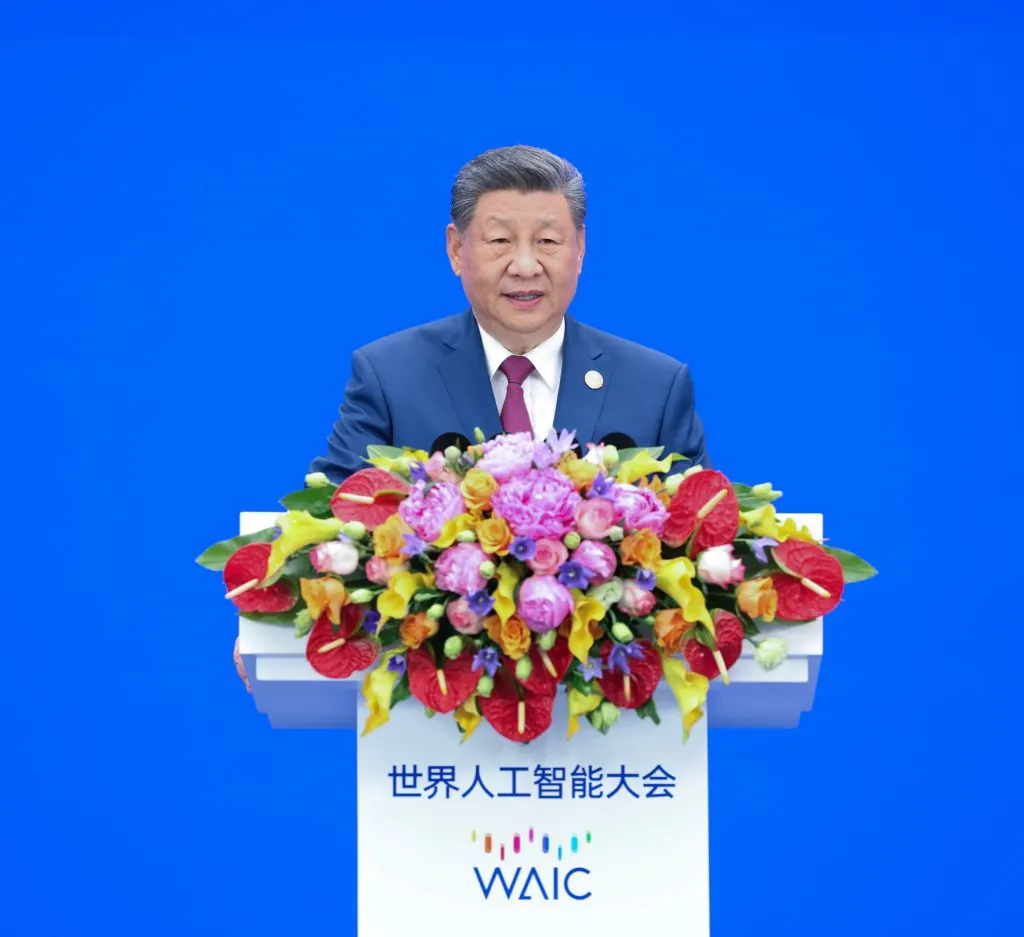
Chinese President Xi Jinping on Friday called for joint efforts to build a just and equitable system for global AI governance. Xi made the call in his keynote speech at the opening ceremony of the 2026 World AI Conference and High-Level Meeting on Global AI Governance held in Shanghai. He announced that China will establish international AI application cooperation centers with the Association of Southeast Asian Nations (ASEAN), the League of Arab States, the African Union and the Community of Latin American and Caribbean States (CELAC). Xi also pledged to help developing countries build artificial intelligence capacity by providing 5,000 training opportunities over the next five years.
These announcements carry profound significance for developing countries that have often struggled to keep pace with rapid technological change. As artificial intelligence reshapes the global economy, nations lacking the necessary infrastructure, skilled workforce and financial resources risk falling further behind. China's latest commitments signal an intention to narrow this technological gap by promoting cooperation, knowledge sharing and capacity building rather than allowing AI development to remain concentrated in a handful of advanced economies.
Artificial intelligence is rapidly becoming an indispensable driver of economic growth and national competitiveness. Countries that successfully integrate AI into their industries stand to improve productivity, modernize public services and stimulate innovation. However, many developing nations continue to face challenges including limited digital infrastructure, inadequate research institutions and shortages of qualified AI professionals. President Xi's pledge to train 5,000 people over the next five years directly addresses one of the most pressing obstacles to digital transformation—the shortage of human capital.
Building local expertise is perhaps the most sustainable investment any country can make. Engineers, programmers, researchers and policymakers equipped with AI knowledge will be able to develop homegrown solutions tailored to local challenges instead of depending entirely on imported technologies. Such capacity building will also enable governments to formulate effective policies governing the ethical use of artificial intelligence while encouraging innovation within their own economies.
For Africa, Xi's proposal to establish AI cooperation with the African Union comes at a particularly important time. The continent possesses one of the world's youngest and fastest-growing populations, many of whom are eager to participate in the digital economy. Yet Africa's AI ecosystem remains relatively underdeveloped due to gaps in connectivity, computing infrastructure and advanced technical education. Partnerships with China could accelerate the establishment of AI innovation centers, research collaborations and technology transfer initiatives that empower African countries to compete in the global digital landscape.
Artificial intelligence also presents enormous opportunities to accelerate development across sectors that are critical to the Global South. In agriculture, AI can help farmers improve crop yields, forecast weather patterns and combat pests more efficiently. In healthcare, AI-powered diagnostic tools can extend quality medical services to remote communities where healthcare professionals are scarce. Education systems can benefit from intelligent learning platforms that personalize instruction and expand access to quality education, while governments can use AI to improve public administration, disaster response and urban planning.
President Xi's emphasis on creating a just and equitable global AI governance system is equally significant. Today, discussions surrounding AI standards, regulations and ethical principles are largely dominated by technologically advanced countries and multinational technology companies. Developing nations often have limited influence despite the fact that AI will profoundly affect their economies and societies. A more inclusive governance framework would allow countries from the Global South to participate meaningfully in shaping international rules governing the development and application of artificial intelligence.
China's proposal reflects its broader philosophy of promoting international cooperation through South-South partnerships. Rather than treating AI as an exclusive strategic asset reserved for a few nations, Beijing advocates wider access to technological progress that contributes to shared prosperity. This approach aligns with China's longstanding support for infrastructure development, industrialization and technological cooperation across Africa, Asia and Latin America.
The establishment of regional AI cooperation centers could also encourage collaboration among developing countries themselves. By sharing research, expertise and practical experiences, countries facing similar development challenges can collectively identify innovative solutions suited to their own economic and social realities. Such cooperation would reduce dependence on external technologies while fostering regional innovation ecosystems.
Ultimately, President Xi Jinping's speech in Shanghai presents more than an ambitious vision for artificial intelligence. It outlines a practical roadmap for making AI more accessible, inclusive and beneficial to developing countries. The commitment to capacity building, regional cooperation and equitable global governance offers hope that the AI revolution can become a catalyst for sustainable development rather than another source of global inequality.
If effectively implemented, these initiatives could enable developing countries to become active contributors to the future of artificial intelligence instead of remaining passive consumers of technologies developed elsewhere. For the Global South, Xi's vision represents an opportunity not only to embrace digital transformation but also to help shape the rules and innovations that will define the next era of human progress.



Comments
No comments yet. Be the first to comment.