
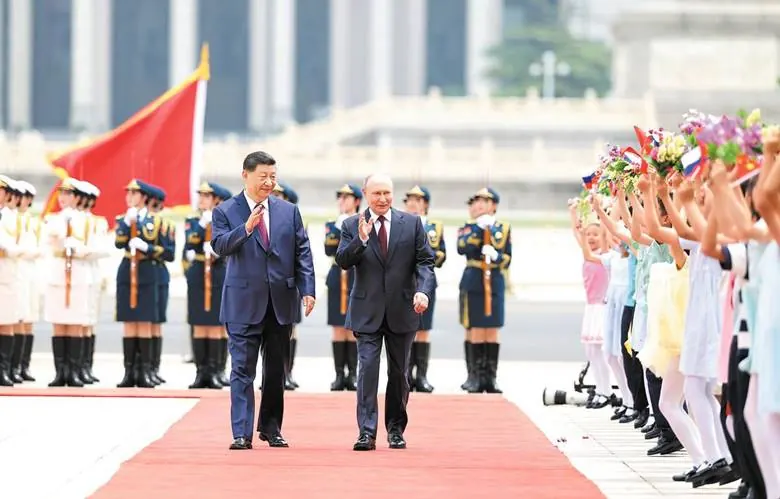
The meeting between Xi Jinping and Vladimir Putin in Beijing that ended on Wednesday has drawn global attention because of its significance to both China and Russia as well as to the wider international community. Coming at a time of geopolitical tensions and ongoing conflicts in different parts of the world, the summit reflected the determination of the two major powers and permanent members of the United Nations Security Council to deepen cooperation and strengthen their strategic partnership.
One of the most important outcomes of the meeting was the extension of the Treaty of Good-Neighborliness and Friendly Cooperation between China and Russia. Originally signed in 2001, the treaty has served as the foundation for political trust, economic cooperation and security coordination between the two countries for the past 25 years. During the joint press conference, Xi Jinping announced that both sides had agreed to extend the treaty again, emphasizing that it is based on “non-alliance, non-confrontation and not targeting any third party.”
The extension of the treaty demonstrates that China and Russia intend to maintain long-term strategic cooperation despite changing global circumstances. It also sends a message that the two countries view their partnership as stable, mature and independent from external pressure. For Beijing and Moscow, preserving strong bilateral ties is increasingly important as they both face growing rivalry and tensions with Western countries.
Economically, the Xi-Putin meeting highlighted the growing importance of bilateral trade between the two nations. According to statements made during the summit, trade between China and Russia has exceeded US$200 billion for three consecutive years, while bilateral trade in the first four months of 2026 reportedly increased by nearly 20 percent. Russia has become one of China’s major suppliers of oil, natural gas and agricultural products, while China exports machinery, electronics, vehicles and industrial goods to Russia.
The growing trade relationship has helped both countries reduce vulnerability to Western economic pressure. Russia, facing sanctions from the United States and Europe, increasingly depends on Chinese markets and investment. China benefits from stable energy supplies and expanded access to Russian resources. Both countries have also promoted trade using local currencies such as the yuan and ruble instead of relying heavily on the US dollar. Putin stressed during the press conference that this financial cooperation helps protect both economies from “external shocks.”
During the press conference, Xi Jinping described the talks as “in-depth, friendly and fruitful,” adding that China-Russia relations now stand “at the highest level in history.” He emphasized that the partnership has become “a prime example of a new type of major-country relationship.” Xi also warned against unilateralism and hegemonism, saying the world risks returning to the “law of the jungle” if countries fail to defend international fairness and justice.
Putin also praised the growing partnership, describing China-Russia relations as being at an “unprecedented high level.” He stated that cooperation between Moscow and Beijing is driven by “strong inherent drivers” and is “not swayed by geopolitical changes.” Putin further stressed that the partnership does not target any third country, but instead contributes to global stability and development.
Beyond bilateral relations, the Xi-Putin meeting carries broader implications for the world. Both leaders strongly advocated for a multipolar international system where no single country dominates global affairs. China and Russia have increasingly coordinated positions on global security, international trade and reform of international institutions. As permanent members of the United Nations Security Council, they continue to present themselves as defenders of multilateralism and international law.
For developing countries, the growing China-Russia partnership represents an alternative vision of global cooperation based on sovereignty, mutual respect and economic development. Many countries in the Global South are closely observing how Beijing and Moscow are challenging Western dominance in international politics and finance. The Xi-Putin meeting clearly demonstrated that both countries remain committed to expanding cooperation in politics, economics, energy and international governance.
As global dynamics continue to evolve, the partnership between China and Russia is likely to remain one of the most influential relationships shaping the future international order.

Comments
No comments yet. Be the first to comment.