
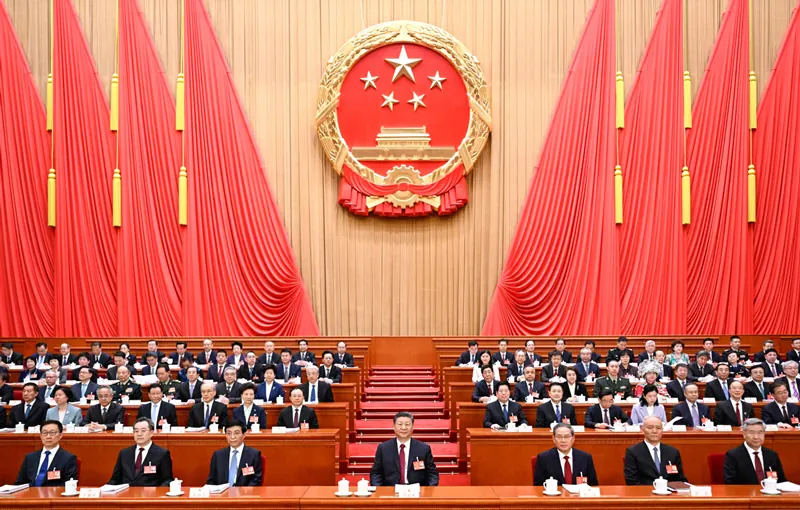
During the month of March every year, Beijing hosts an important gathering known as the “Two Sessions” which takes place inside the Great Hall of the People. The meeting started on Wednesday 4th to 12th March. This major political event consists of the meetings of the National People’s Congress (NPC) and the Chinese People’s Political Consultative Conference (CPPCC).This year's NPC delegates will approve the next Five Year Plan, the blueprint that China will follow between 2026 and 2030. Beyond its ceremonial significance, the Two Sessions serve as a vivid example of China’s concept of Whole-Process People’s Democracy — a model that emphasizes participation, consultation, and responsiveness throughout the governance process.
Whole-Process People’s Democracy is rooted in the idea that democracy is not limited to casting a vote during periodic elections. Instead, it encompasses continuous participation in decision-making, implementation, and supervision. In this framework, democracy is seen as a living process rather than a single event. The Two Sessions illustrate how this principle functions in practice.
One of the distinctive features of the Two Sessions is the diversity of its participants. Delegates and members come from across China’s vast geographic and social landscape. They include farmers from remote villages, factory workers from industrial cities, village teachers shaping the next generation, rural doctors serving grassroots communities, scientists, entrepreneurs, and representatives of ethnic minorities. Their presence signals an effort to ensure that voices from different sectors of society are heard at the national level.
This inclusive structure reflects a broader philosophy: governance should be informed by real-life experience. For example, a rural doctor attending the session can raise concerns about healthcare access in remote areas. A private business owner can share challenges related to market regulation or innovation. A farmer may discuss agricultural modernization or rural revitalization. These firsthand perspectives are not abstract policy discussions; they are grounded in lived realities.
During the meetings, delegates review government work reports, examine economic and social development plans, and propose motions and suggestions. The process involves consultation, debate, and revision. While the NPC holds the authority to enact laws and approve major policies, the CPPCC functions as a platform for consultation and advisory input. Together, they form a mechanism where decision-making is shaped by multiple channels of feedback.
Critically, Whole-Process People’s Democracy extends beyond the Two Sessions themselves. Before proposals reach Beijing, they are often informed by consultations at local levels, community discussions, and surveys. After policies are adopted, implementation is monitored, and feedback continues to flow upward. In this sense, participation does not begin or end in the Great Hall of the People; it is embedded throughout the governance cycle.
The emphasis on broad representation also aligns with China’s efforts to address regional disparities and social transformation. As the country undergoes rapid urbanization, technological advancement, and economic restructuring, policy decisions affect diverse groups differently. By incorporating participants from varied backgrounds, the system aims to balance efficiency with inclusiveness.
Observers may interpret democracy through different cultural and historical lenses. In China Whole-ProcessPeople’s Democracy is a home grown model adapted to national conditions, emphasizing stability, development, and collective consultation. Its advocates argue that effective governance requires both participation and the capacity to deliver tangible improvements in people’s livelihoods — such as poverty alleviation, infrastructure expansion, healthcare reform, and educational access.
The Two Sessions therefore serve not only as an annual political event but also as a symbol. They represent an attempt to institutionalize dialogue between the state and society within a structured framework. The sight of delegates from varied professions gathering under one roof conveys a message of shared responsibility for national development.
In a rapidly changing world, governance systems are continually tested by new challenges. China’s Whole-Process People’s Democracy, as demonstrated through the Two Sessions, reflects one approach to integrating participation with policymaking continuity. Whether viewed domestically or internationally, it underscores an ongoing effort to align political processes with the practical needs and aspirations of a vast and diverse population.
Ultimately, the significance of the Two Sessions lies not only in the policies adopted but in the principle they seek to embody: that governance should involve the people at every stage, turning representation into an active and continuous process rather than a single moment in time.
Comments
No comments yet. Be the first to comment.