
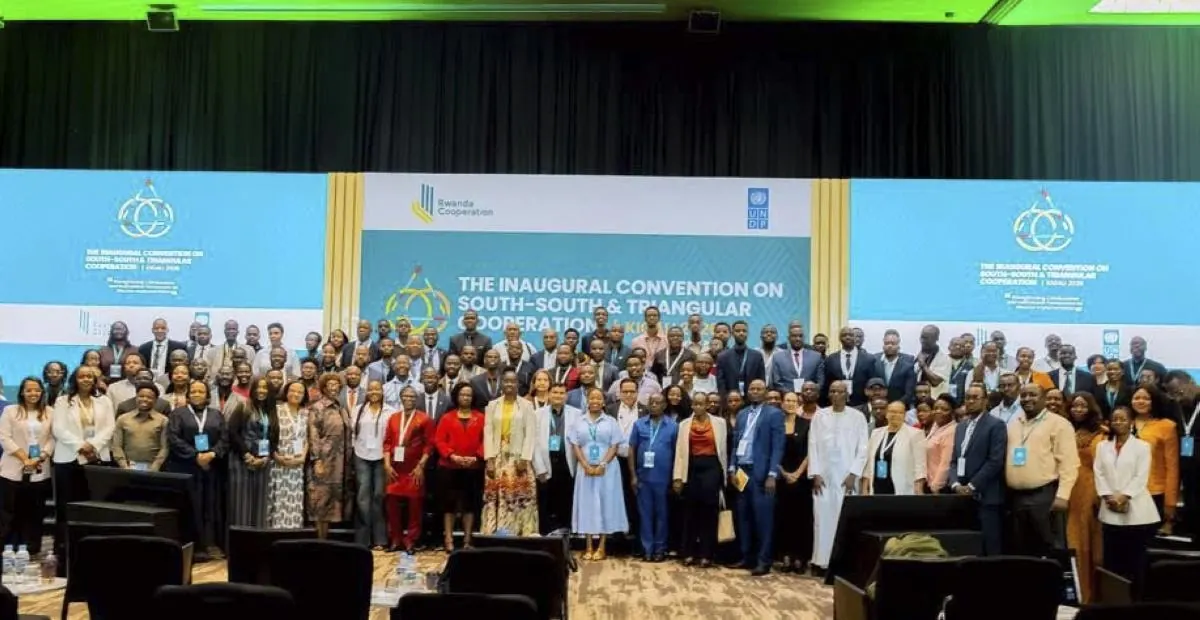
The world is witnessing a gradual transformation in the way nations cooperate for development. For decades, international partnerships were largely shaped by a traditional model in which developed countries provided assistance to developing nations. Today, however, countries of the Global South are increasingly sharing experiences, technologies, and policy solutions among themselves. This emerging approach was highlighted at the inaugural Convention on South-South and Triangular Cooperation held in Kigali, Rwanda, where leaders called for a more balanced and inclusive framework for global development. In many ways, Rwanda’s Cooperation Initiative and China’s vision for global governance reflect similar principles and aspirations.
Speaking at the convention, Rwanda’s Minister of Foreign Affairs and International Cooperation, Olivier Nduhungirehe, emphasized that development partnerships should be based on equality, mutual respect, and shared learning. Through the Rwanda Cooperation Initiative (RCI), the country seeks to share lessons from its own development journey with other nations. Rather than positioning itself as a donor, Rwanda presents itself as a partner willing to exchange knowledge, provide technical assistance, and support capacity building.
This philosophy mirrors China’s approach to international cooperation. Over the past decades, China has consistently advocated for a global governance system that respects the diversity of development paths and allows countries to determine their own priorities. China’s governance initiatives emphasize dialogue, consultation, and mutual benefit rather than imposing solutions from outside. The underlying belief is that every country possesses valuable experiences that can contribute to global development.
The similarities between the Rwanda Cooperation Initiative and China’s governance vision are particularly evident in their support for South-South cooperation. Both recognize that developing countries face unique challenges and often possess practical solutions that are highly relevant to one another. Rwanda’s community-based health insurance system, for example, has attracted interest from many African and developing countries seeking to expand healthcare access. Likewise, Kenya’s success in mobile money innovation demonstrates how solutions originating in the Global South can address challenges that are common across developing economies.
China has followed a similar path by sharing its experiences in poverty reduction, agricultural modernization, infrastructure development, and digital transformation. Many African countries have studied aspects of China’s development journey, adapting lessons to suit their own national conditions. Importantly, both Rwanda and China emphasize adaptation rather than imitation. Successful policies must be tailored to local realities and institutional contexts.
Another important area of convergence is the promotion of multilateral cooperation. Rwanda’s vision of Kigali as a hub for South-South and triangular cooperation seeks to bring together governments, development partners, and international organizations to work collectively on common challenges. China’s global governance proposals similarly advocate for stronger multilateral institutions and broader participation in international decision-making. Both approaches recognize that issues such as poverty, public health, climate change, and economic development cannot be solved by individual countries acting alone.
The emphasis on equality also distinguishes both models. Rwanda’s leaders have argued that countries should engage as peers rather than as beneficiaries and benefactors. This principle is echoed in China’s calls for mutual respect among nations regardless of size, wealth, or political system. Such an approach encourages trust and creates conditions for genuine partnership.
The growing importance of South-South cooperation reflects changing global realities. Developing countries are no longer merely recipients of knowledge; they are increasingly producers of innovation and development solutions. Rwanda’s remarkable progress in governance, healthcare, and technology demonstrates how local experiences can inspire others. China’s rapid transformation from poverty to prosperity offers another example of how development lessons can be shared across borders.
As the global community searches for more effective and inclusive development models, the Rwanda Cooperation Initiative and China’s governance vision offer valuable perspectives. Both advocate cooperation over confrontation, dialogue over division, and partnership over dependency. Their shared emphasis on mutual learning, multilateralism, and respect for national development paths highlights an emerging international order in which countries work together as equals to pursue common prosperity and sustainable development.
In a rapidly changing world, such approaches may prove increasingly important in building a more balanced and cooperative global future.
Gerald Mbanda is a researcher and publisher on China-Africa Cooperation and development.

Comments
No comments yet. Be the first to comment.