
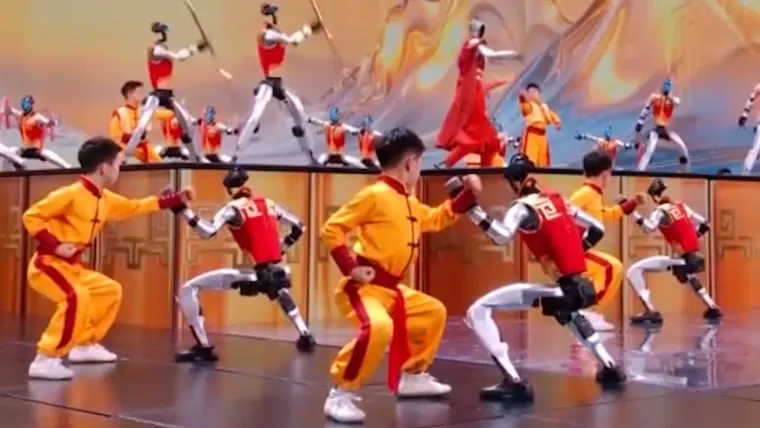
Every year, the arrival of the Chinese Spring Festival transforms cities and villages into oceans of red lanterns, fireworks, and joyful reunion dinners. It is a time when tradition takes center stage: elders distribute red envelopes, families honor their ancestors, and millions travel home in the world’s largest annual migration. Yet this year, alongside the familiar rhythms of celebration, something new stepped into the spotlight—humanoid robots.
The Spring Festival, also known as Chinese New Year, has always evolved with the times. From handwritten couplets to digital greetings sent over smartphones, the festival reflects the spirit of each era. In 2026, that spirit included artificial intelligence. Humanoid robots appeared not as distant laboratory experiments but as performers, hosts, and interactive companions woven into the festivities.
During large-scale gala shows reminiscent of the famous CCTV Spring Festival Gala, humanoid robots danced in synchronized routines with human performers. Their movements were fluid, precise, and surprisingly expressive. Unlike the industrial robots found in factories, these machines were designed with human-like proportions and faces capable of subtle expressions. They bowed to the audience in traditional fashion, waved in greeting, and even mimicked classical Chinese dance gestures. The symbolism was powerful: ancient art forms interpreted through the lens of cutting-edge technology.
Beyond the television stage, public squares and shopping malls in cities like Beijing and Shanghaifeatured interactive robot showcases. Families gathered around as humanoid robots recited Tang poetry, answered children’s questions about zodiac animals, and guided visitors through digital lantern displays. Some robots were programmed to explain the legend of Nian, the mythical beast frightened away by red decorations and loud noises. In these moments, AI became a storyteller, preserving heritage while presenting it in a format that fascinated younger generations.
The use of humanoid robots during the Spring Festival was not merely entertainment—it was a statement. China has long emphasized innovation as a pillar of national development. The presence of AI-driven robots at the country’s most cherished holiday illustrated how deeply technological progress has become integrated into everyday life. Rather than replacing tradition, the robots complemented it. They did not take over lion dances or temple fairs; instead, they performed alongside them, demonstrating harmony between old and new.
What made this integration especially striking was the cultural sensitivity embedded in the programming. Developers ensured the robots understood social etiquette specific to the festival. They delivered blessings in Mandarin and regional dialects, used respectful forms of address for elders, and even simulated the gesture of offering tea. Their ability to interpret speech and respond naturally showcased advances in natural language processing and machine learning. The robots were not simply executing pre-coded lines; they were adapting to real-time interactions.
Children, in particular, seemed captivated. For many, this was their first close encounter with a humanoid robot outside of science fiction. Instead of perceiving AI as abstract or intimidating, they experienced it as playful and friendly. A robot that could explain the meaning of the Year of the Horse while posing for selfies bridged imagination and reality. In this way, the festival became an informal classroom, introducing AI literacy through celebration.
Critically, the spectacle also sparked conversations among adults. Some marveled at how far robotics had advanced in just a decade. Others reflected on how AI might reshape work, education, and family life. Yet within the festive context, the mood remained optimistic. The robots were symbols of possibility rather than disruption. Their presence suggested that technological advancement could strengthen cultural confidence rather than erode it.
The Spring Festival has always been about renewal—welcoming a new year with hope and anticipation. This year, humanoid robots embodied that spirit of renewal. They represented a future in which artificial intelligence is not an isolated industry but a natural extension of society. Red lanterns glowed above them, firecrackers echoed in the distance, and families laughed as silicon and steel joined in the celebration.
In blending centuries-old customs with state-of-the-art robotics, China offered the world a vivid image of the AI revolution rooted in cultural continuity. The message was clear: innovation does not have to replace heritage. Instead, it can illuminate it.


Comments
No comments yet. Be the first to comment.