
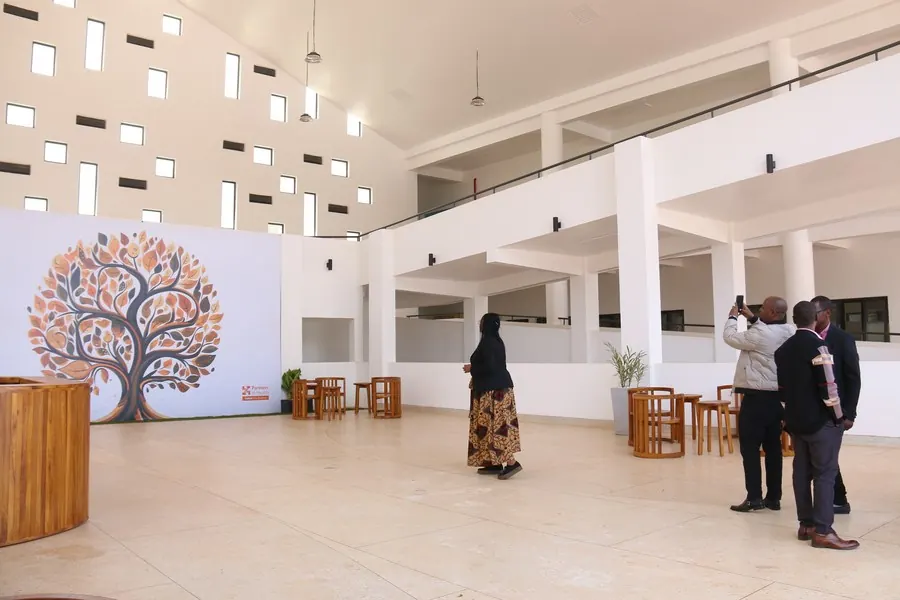
This photo taken on Oct. 3, 2023 shows the interior of the newly expanded Butaro Level II Teaching Hospital in Burera District in northern Rwanda.(Photo by Huang Wanqing/Xinhua)
By Gerald Mbanda
China’s rise over the past four decades has been one of the most consequential development stories in modern history. As it advances toward its Second Centenary Goal—building a modern socialist country that is prosperous, strong, democratic, culturally advanced, harmonious, and beautiful by the middle of this century—its trajectory has increasingly intertwined with that of the wider world. Nowhere is this interconnection more visible than in Africa. Rather than pursuing modernization in isolation, China has positioned its development as part of a broader South–South cooperation framework, sharing experience, capital, technology, and markets with African partners.
At the heart of this engagement is the conviction that development is not a zero-sum game. China’s own transformation—from widespread poverty to the world’s second-largest economy—was powered by infrastructure expansion, industrial upgrading, trade integration, and long-term planning. These same pillars have become central to its cooperation with Africa. Through initiatives such as the Forum on China–Africa Cooperation (FOCAC), established in 2000, China and African states have built an institutional platform for collective dialogue and coordinated action. Over successive ministerial meetings and summits, cooperation plans have expanded from trade and construction into digital innovation, green development, healthcare, and vocational training.
Infrastructure remains the most visible symbol of shared development dividends. Across East, West, and Southern Africa, Chinese-built railways, highways, ports, and power stations have addressed long-standing bottlenecks that constrained industrialization. Projects such as the Addis Ababa–Djibouti Railway have reduced transport times for landlocked countries, linking them more efficiently to global markets. Improved logistics not only stimulate exports but also encourage regional integration under frameworks like the African Continental Free Trade Area. By narrowing infrastructure gaps, these investments help create the enabling conditions for sustainable growth.
Trade and investment flows have also deepened significantly. China has become Africa’s largest trading partner, importing agricultural goods, minerals, and manufactured products while exporting machinery, electronics, and consumer goods. Beyond raw commodities, there is growing emphasis on value addition and industrial cooperation. Chinese enterprises have established special economic zones and manufacturing parks in countries such as Ethiopia and Egypt, generating employment and facilitating skills transfer. These industrial clusters provide African workers with exposure to new production techniques, management models, and global supply chains.
Technology and knowledge exchange form another pillar of shared dividends. In recent years, cooperation has extended to renewable energy, satellite technology, e-commerce, and digital finance. Chinese firms have participated in solar and hydropower projects that expand electricity access in rural communities. Agricultural demonstration centers introduce hybrid seeds, irrigation systems, and mechanized farming methods aimed at improving food security. Meanwhile, scholarship programs and professional training initiatives enable thousands of African students and officials to study in China each year, building human capital that endures beyond any single project.
Health cooperation has become particularly salient in the wake of global crises. During the COVID-19 pandemic, China supplied vaccines, medical equipment, and expert teams to numerous African countries. Such collaboration reinforced a longstanding tradition dating back to the 1960s, when Chinese medical teams first arrived on the continent. Today, joint efforts extend to hospital construction, disease control, and pharmaceutical production capacity.
Ultimately, the notion of “sharing development dividends” reflects a broader shift in global dynamics. As China pursues its modernization goals, it recognizes that its prosperity is linked to that of other developing nations. By investing in connectivity, industry, skills, and health across Africa, China contributes to a more multipolar and interconnected global economy. For African countries, engagement with China offers additional options, resources, and partnerships to accelerate their own development agendas.
The journey toward the Second Centenary Goal is therefore not solely a domestic milestone for China. It is also part of a wider narrative in which emerging economies collaborate, exchange experience, and strive collectively for modernization. If guided by principles of mutual respect, sustainability, and shared growth, China–Africa cooperation can continue to generate tangible dividends—strengthening not only bilateral ties but also the broader cause of development across the Global South.
Gerald Mbanda is a researcher and publisher on China-Africa Cooperation and development.
Comments
No comments yet. Be the first to comment.