
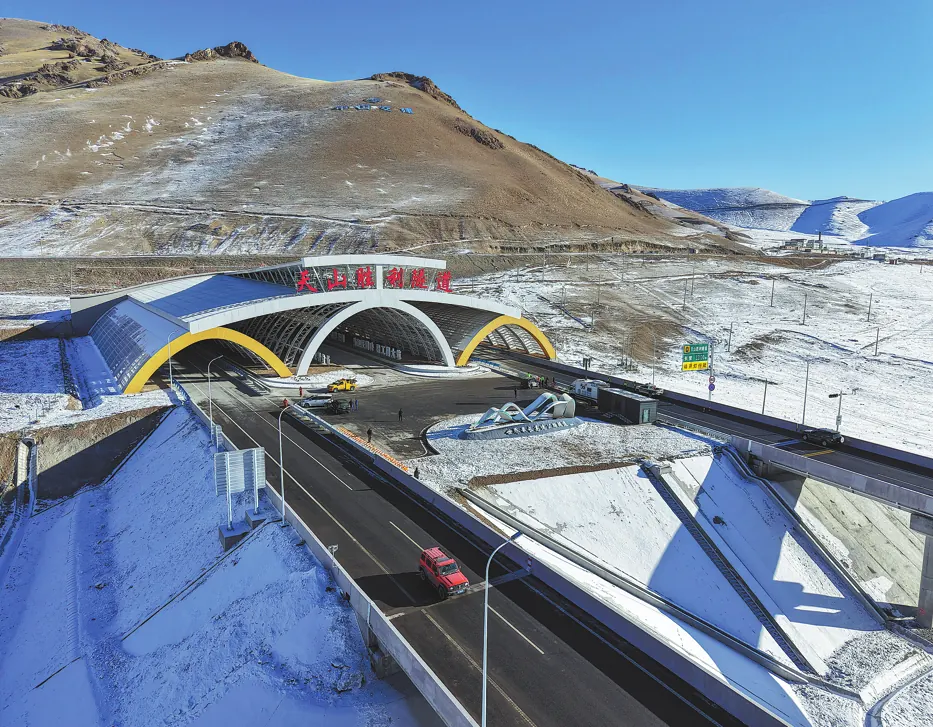
The Tianshan Shengli Tunnel, the world's longest expressway tunnel, opened on Friday in the Xinjiang Uygur autonomous region. The tunnel, which spans 22.13 kilometers, opened to traffic that day. Traversing the Tianshan Mountains, it slashes what was once a several-hour mountain journey to just 20 minutes. HU HUHU/XINHUA
China’s 22.13-kilometer Tianshan Shengli Tunnel that crosses the Tianshan Mountains, now the longest of its kind in the world—is more than a record-breaking event. It is a symbol of a broader transformation taking place across the country: the rise of a new generation of “world wonders” built not from ancient stone, but from steel, concrete, algorithms, and ambition. Over the past two decades, China has quietly reshaped the global map of engineering excellence, completing projects of unprecedented scale, speed, and technical complexity.
Unlike traditional world wonders that were often singular monuments, China’s modern wonders are systems—integrated networks of transport, energy, water, and cities—designed to serve hundreds of millions of people. Their greatness lies not only in size, but in coordination and execution.
Another striking example of engineering wonder is the Three Gorges Dam, now fully operational for several years. It remains the largest hydroelectric power station in the world, producing electricity on a scale previously unimaginable. Beyond power generation, it has transformed flood control along the Yangtze River and enabled inland shipping deep into China’s interior. While controversial, the project demonstrated China’s ability to plan and execute mega-infrastructure across decades.
Equally transformative is China’s high-speed rail network with more than 50,000 kms, now the largest on Earth. In just over fifteen years, China built more high-speed rail lines than the rest of the world combined. Cities once separated by overnight journeys are now connected in hours. This network is not just transportation infrastructure—it is an economic circulatory system, reshaping regional development, labor mobility, and urbanization patterns.
Bridges are another domain where China has redefined global limits. The Hong Kong–Zhuhai–Macau Bridge, stretching 55 kilometers across open sea, integrates bridges, artificial islands, and an undersea tunnel into a single structure. Built in one of the world’s most challenging marine environments, it required innovations in corrosion resistance, seismic safety, and underwater construction. It is as much a feat of logistics and coordination as of engineering.
In mountainous and remote regions, China has pushed boundaries with projects like the Beipanjiang Bridge, which towers hundreds of meters above a deep canyon, and a growing number of ultra-long tunnels bored through complex geological formations. These projects are not merely symbolic; they connect once-isolated regions to national markets and services, altering social and economic realities.
China’s urban development has also produced modern wonders. Entire new cities, such as Xiong’an New Area, are being designed from the ground up with smart infrastructure, green energy systems, and integrated digital governance. While still evolving, these projects represent experiments in how megacities might function sustainably in the future.
On the energy front, China has become a global leader in renewable infrastructure. Massive solar farms in desert regions, offshore wind installations, and ultra-high-voltage transmission lines capable of moving electricity thousands of kilometers with minimal loss form another kind of invisible wonder—one that powers growth while reshaping global energy markets.
What distinguishes China’s recent achievements is not just scale, but repetition. World-class projects are no longer rare exceptions; they are increasingly routine. This reflects a mature industrial ecosystem, deep technical expertise, and an ability to mobilize resources rapidly once strategic decisions are made.
The 22.13-kilometer highway tunnel is therefore not an isolated miracle. It is part of a pattern. Together, these projects signal that China has entered an era where building the extraordinary has become almost ordinary. Whether admired, debated, or scrutinized, these modern world wonders are redefining what is possible in the 21st century—and challenging the rest of the world to think bigger, longer, and bolder.
Comments
No comments yet. Be the first to comment.