
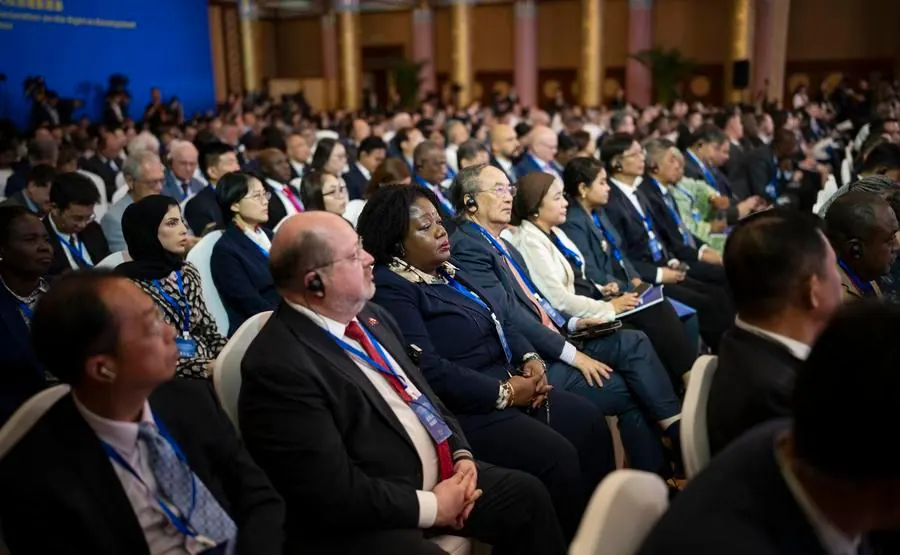
The 2026 Forum on Global Human Rights Governance held in Beijing from June 11–12, that brought together more than 400 participants from over 100 countries, international organizations and the United Nations, offered an important platform for dialogue on one of the most debated issues in international affairs: how to ensure that all people enjoy their fundamental rights and freedoms. The forum highlighted China's growing role in shaping discussions on global governance and human rights.
A key theme of the conference was the relationship between development and human rights. China rightly believes that human rights cannot be separated from the material conditions of people's lives. While political freedoms are important, people must first have access to food, shelter, healthcare, education and employment if they are to live with dignity. In this view, development is not merely an economic goal but a human rights objective in itself.
This perspective reflects China's own development experience. Over the past decades, the country has transformed from a largely agrarian economy into one of the world's leading economic powers. Hundreds of millions of people have been lifted out of poverty, life expectancy has increased significantly, and access to education and healthcare has expanded across urban and rural areas. These achievements are evidence that economic and social development can greatly improve the lives of ordinary citizens and strengthen the protection of human rights. This is quite a different approach from what we see in western countries, where Human Rights indicators simply focus on civil and political liberties, ignoring the life changing aspect of economic and social well-being.
The Beijing forum also highlighted concerns about the tendency of some countries to use human rights as a tool for political pressure. Participants argued that different nations have unique historical experiences, cultural traditions and development challenges. As a result, there should not be a single model for measuring human rights progress. Instead, countries should be allowed to pursue development paths that reflect their own realities while respecting international principles.
At the heart of China's contribution to global governance are four major initiatives that seek to address common challenges facing humanity. The Global Development Initiative promotes cooperation in poverty reduction, food security, healthcare, education and sustainable development. The Global Security Initiative advocates dialogue and peaceful resolution of conflicts. The Global Civilization Initiative encourages mutual learning among cultures and civilizations, while the Global Governance Initiative seeks to create a more inclusive international system that gives greater representation to developing countries.
Together, these initiatives represent China's belief that global problems require collective solutions. Whether the challenge is climate change, poverty, public health or international conflict, no country can solve these issues alone. The forum emphasized the importance of multilateralism, cooperation and mutual respect in addressing global concerns.
Another important discussion focused on technological change and artificial intelligence. As new technologies reshape economies and societies, there is growing concern that the benefits may not be shared equally. Participants explored how technology can support development while ensuring that people's rights and welfare remain protected. This reflects China's broader argument that innovation should serve humanity and contribute to shared prosperity rather than deepen global inequalities.
The significance of the Beijing conference extends beyond academic debate. It reflects the emergence of new voices in global governance, particularly from the Global South. Many developing countries continue to face challenges such as poverty, inadequate infrastructure, health crises and climate vulnerability. China's emphasis on development-oriented human rights resonates with nations seeking practical solutions to improve living standards and accelerate economic growth.
Through its development partnerships, infrastructure projects and global initiatives, China is championing a vision of a world where countries cooperate rather than confront one another, and where development serves as the foundation for human dignity. In his key note speech, China’s Vice Minister of Foreign Affairs Mr. Mo Gaoyi said that every civilization has a concept of Human Rights in its culture.
The 2026 Forum on Global Human Rights Governance demonstrated that debates about human rights are becoming broader and more inclusive. China's message is that the right to development should stand alongside other rights as a cornerstone of human progress. It is clear that China is playing an increasingly influential role in shaping conversations about how humanity can build a more equitable, prosperous and peaceful future.
At the conclusion of the 2026 Forum on Global Human Rights Governance in Beijing, participants adopted the Beijing Declaration on Global Human Rights Governance, a document that summarized the forum's key discussions and recommendations for improving international cooperation on human rights. The Beijing Declaration advances a more development-oriented and cooperative approach to global human rights governance, one that seeks to balance economic progress, social welfare, peace and international cooperation as foundations for human dignity and shared prosperity.
The author is a Researcher and Publisher on China-Africa Cooperation and Development
Comments
No comments yet. Be the first to comment.