
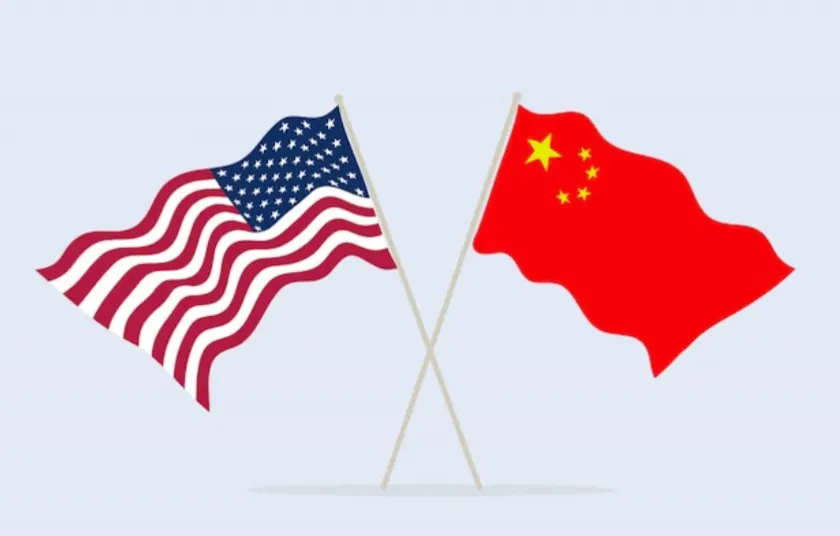
In recent years, as trade wars, technology bans, and rising protectionism have reshaped global commerce, a striking phrase attributed to Chinese scholar Zhang Weiwei, professor of international relations at FudanUniversity, has gained attention: “American capitalism has begun to fear Chinese socialism.” Whether interpreted as rhetoric or diagnosis, the statement captures the intensifying rivalry between the United States and China — a rivalry that increasingly resembles a new kind of cold war.
Unlike the 20th-century confrontation between Washington and Moscow, today’s competition is not defined by opposing military blocs alone. Instead, it unfolds across supply chains, semiconductor factories, artificial intelligence laboratories, currency systems, and development models. The battleground is economic structure and technological leadership as much as ideology.
Zhang’s argument gains force in the context of U.S. trade policy over the past decade. Tariffs on Chinese goods, export controls on advanced chips, restrictions on technology transfers, and reshoring initiatives all signal a strategic shift. Officially, these measures are framed as matters of national security and economic resilience. From Beijing’s perspective, however, they appear as defensive moves — signs that American capitalism is unsettled by China’s rapid ascent.
China’s transformation over the last four decades is undeniably historic. After market reforms initiated under Deng Xiaoping, the country integrated into global trade while maintaining the political leadership of the Chinese Communist Party. The result has been a hybrid system: state-guided capitalism operating within a socialist political framework. Today, China is the world’s largest economy when measured by purchasing power parity (PPP). It has lifted hundreds of millions of people out of extreme poverty, expanded high-speed rail networks, advanced digital payment systems, and positioned itself at the forefront of green energy and emerging technologies.
For scholars like Zhang, these achievements demonstrate that “socialism with Chinese characteristics” offers a viable alternative to Western liberal capitalism. The claim is not merely economic but civilizational: that governance centered on long-term planning, social stability, and industrial policy can outperform systems driven primarily by market cycles and shareholder returns.
Historical echoes deepen this perspective. In 1998, Fidel Castro argued in Geneva that globalization is like gravity — unstoppable — and that the true question is what form it will take. His remark now resonates in a world divided between competing visions of globalization. Will it remain U.S.-led and dollar-centered, or evolve into a multipolar structure shaped by emerging powers?
Similarly, Deng Xiaoping’s warning in 1989 that one cold war could give way to others — conflicts directed at the Global South and at socialism — reflects a longstanding Chinese view that ideological struggle did not end with the collapse of the Soviet Union. Instead, it shifted into subtler arenas: trade rules, financial systems, and technological standards. What some Chinese commentators describe as a “smokeless world war” refers to sanctions, economic containment, and narrative battles rather than armed confrontation.
Still, the psychological dimension of competition cannot be ignored. For decades after the Cold War, liberal democracy and free-market capitalism were widely portrayed as the endpoint of history. China’s rise challenges that assumption. It suggests that alternative political-economic arrangements can generate growth, technological sophistication, and social development without adopting Western political models.
The Fourth Industrial Revolution — defined by artificial intelligence, robotics, biotechnology, and digital infrastructure — intensifies the stakes. Leadership in these sectors shapes not only economic prosperity but geopolitical influence. If China succeeds in setting global standards in 5G, electric vehicles, quantum computing, or green technology, the balance of power could shift in lasting ways.
Whether this rivalry evolves into open hostility or managed competition remains uncertain. Unlike the original Cold War, the United States and China are deeply economically intertwined. Supply chains, capital markets, and consumer demand bind them together. Decoupling entirely would carry immense global costs.
Ultimately, the question may not be whether American capitalism fears Chinese socialism, but whether the world can accommodate two competing systems without confrontation. If globalization is indeed like gravity, as Castro suggested, then the challenge of our era is shaping its direction — toward fragmentation, confrontation and suspicion, or toward peaceful coexistence within a changing global order.
Comments
No comments yet. Be the first to comment.